Last updated: October 2026
This content was written and reviewed by the Medical Content Department at LERRA Clinic.
The cost of All-on-6 dental implants in Turkey ranges approximately from $4,000 to $12,000 per jaw, compared with around $15,000–$30,000 in the UK, $10,000–$22,000 in Germany, and $24,000–$40,000 in the United States.
The price difference is mainly due to lower labor, laboratory, and operating costs, rather than necessarily reflecting differences in materials. However, quality depends on the clinic’s licensing and the type of implants used.
These figures are approximate market estimates based on published clinic offers. Prices vary from one case to another, and the final cost is determined after a clinical examination and diagnostic imaging.
Table of Contents
What Is All-on-6 Dental Implant Treatment, and Who Is It Suitable For?
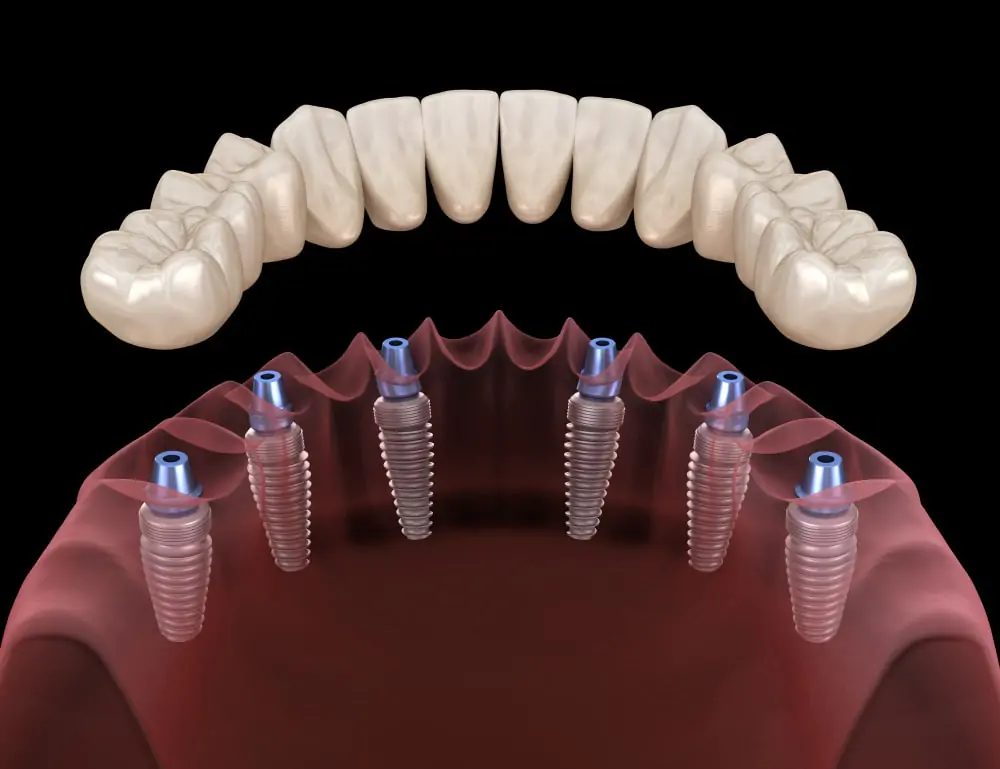
All-on-6 is a full-arch tooth replacement technique in which six titanium implants are placed in the jawbone to support a fixed bridge that covers the entire dental arch.
All-on-6 dental implants are suitable for people who have lost all or most of their teeth in one or both jaws and have sufficient bone, or whose bone can be augmented through bone grafting.
Before making a decision, the dentist evaluates the amount and density of the bone using cone-beam computed tomography (CBCT) and examines the health of the gums and the patient’s overall medical condition.
This treatment is one of the options available for full-mouth rehabilitation in Turkey, with the appropriate treatment plan determined according to each patient’s individual condition.
How Much Does All-on-6 Cost in Turkey Compared with the UK, Germany, and the USA?
According to market estimates, All-on-6 treatment in Turkey costs approximately $4,000–$12,000 per jaw. In comparison, the cost ranges from $15,000–$30,000 in the UK, $10,000–$22,000 in Germany, and $24,000–$40,000 in the United States.
These are approximate price ranges, and the final cost is determined after a clinical examination.
| Country | Approximate Cost per Jaw (USD) | What the Price Usually Includes | Number of Trips |
|---|---|---|---|
| Turkey | $4,000–$12,000 | Usually a package including the implants, temporary and final bridges, and sometimes accommodation and transfers | Usually two trips |
| United Kingdom | $15,000–$30,000 | Generally, treatment only | No travel required for residents; multiple local visits |
| Germany | $10,000–$22,000 | Treatment only; included services vary between clinics | No travel required for residents; multiple local visits |
| United States | $24,000–$40,000 | Treatment only; diagnostic imaging and extractions may be charged separately | No travel required for residents; multiple local visits |
The cost of All-on-6 dental implants in Turkey and other countries varies depending on the implant brand, the material used for the final bridge, and whether bone grafting is required.
The cost of treating both jaws is approximately twice these figures.
In the UK, the National Health Service (NHS) explains that dental implants are generally available only through private treatment. They are rarely provided through the NHS, except in specific circumstances, such as for people who cannot wear dentures because of conditions such as mouth cancer or injuries.
The guide to dental implants in Turkey provides a broader overview of implant types, prices, and safety standards.
Why Are All-on-6 Prices Lower in Turkey?
All-on-6 treatment is less expensive in Turkey than in Europe and the United States because of lower medical staff salaries, dental laboratory costs, clinic rental expenses, and operating costs, as well as differences in the exchange rate of the Turkish lira.
Many clinics use the same international implant systems found in Europe, meaning that the price difference often lies in the cost of the service.
However, a lower price does not automatically mean that the quality is identical.
An unusually low offer may reflect the use of implant systems with less scientific documentation, a temporary bridge presented as a final one, or the exclusion of essential items from the quoted price.
Therefore, the correct approach is to compare offers with identical inclusions rather than simply comparing the total prices.
What Should a Price Quote Include Before You Compare?
Before comparing a Turkish quote with one from your home country or another clinic, make sure that each quote specifies the following items in writing:
- The implant manufacturer’s name and implant model, clearly stated in the quote.
- The abutments that connect the implants to the bridge.
- The fixed temporary bridge fitted after surgery.
- The material used for the final bridge: zirconia or a hybrid bridge made of acrylic on a metal framework.
- Three-dimensional CT scans and X-rays.
- The extraction of any remaining teeth, including the number of teeth to be removed.
- Bone grafting or sinus lifting, if required, with the price of each procedure listed separately.
- Hotel accommodation, transfers, and follow-up visits, including whether the second trip is covered.
Is the Quality of All-on-6 Treatment in Turkey Comparable to Europe and the USA?
Yes, the quality of All-on-6 treatment in Turkey can be comparable to that in Europe and the United States, provided that the facility holds an international health tourism authorization, the implants belong to a scientifically documented international system, and treatment is planned using three-dimensional imaging.
Quality is determined by the individual clinic and dentist, not by the country itself.
Three factors make a difference in quality:
- The dentist’s experience: Experience in full-arch rehabilitation is essential, rather than experience in single-tooth implants alone.
- The implant system: Examples of established international implant systems with a long history of clinical research include Straumann, Nobel Biocare, and Osstem.
- Digital planning: CT imaging and guided surgery help determine the precise position of each implant before surgery.
The page on Swiss Straumann Dental Implants discusses one of these systems in detail. However, the choice of implant type should always be made according to the patient’s individual clinical condition.
How Can You Verify a Clinic’s License for Medical Tourism in Turkey?
To verify a clinic’s authorization for medical tourism in Turkey, request a copy of the facility’s International Health Tourism Authorization Certificate. Make sure that the facility’s name on the certificate matches the name of the clinic where you will receive treatment, and verify that any intermediary you work with holds its own authorization certificate.
- Request the facility’s International Health Tourism Authorization Certificate.
- Check that the facility’s name on the certificate matches the clinic’s actual name and address.
- Ask for the name and specialization of the treating dentist.
- Ask whether your treatment includes complication insurance and what the insurance covers.
- Obtain the treatment plan and the implant specifications in writing before traveling.
This field is currently regulated by the International Health Tourism and Tourist Health Regulation, published in the Turkish Official Gazette on April 26, 2025 (Issue No. 32882). This regulation repealed the previous regulation issued on July 13, 2017.
The regulation requires healthcare facilities and intermediary organizations to obtain authorization certificates. The Ministry of Health issues certificates to healthcare facilities, while the International Health Services Inc. (USHAŞ) issues certificates to intermediary organizations.
The regulation also requires healthcare facilities to maintain insurance covering complications arising from surgical and interventional procedures performed in an operating room. In addition, hospitals and medical centers must obtain accreditation from the Turkish Healthcare Quality and Accreditation Institute (TÜSKA).
LERRA Clinic coordinates treatment at partner clinics and hospitals that hold health tourism authorization. The page on Dental Implant Safety in Turkey explains these safety standards in greater detail.
All-on-6 vs. All-on-4: Which Is Right for You?
Choosing between All-on-6 and All-on-4 is a medical decision that depends on bone volume and bite force, rather than one treatment being inherently superior or inferior in quality.
When the available bone allows it, six implants distribute chewing forces across more points. By contrast, four angled implants may help avoid bone grafting in some cases involving insufficient bone.
In a randomized clinical trial that followed 40 patients for five years after the placement of an immediately loaded fixed bridge in the upper jaw, no statistically significant difference was found between the two groups in implant failure or the loss of surrounding bone.
The researchers noted that longer-term studies are needed to confirm these findings. In other words, the number of implants alone does not determine the success of treatment.
| Criterion | All-on-4 | All-on-6 |
|---|---|---|
| Number of implants | 4, with the two posterior implants usually angled | 6 |
| Need for bone grafting | Less likely to be necessary in some cases of insufficient bone | May be necessary if there is insufficient bone in the posterior region |
| Distribution of chewing forces | Across four points | Across six points |
| Relative cost | Usually lower | Usually higher |
For a more comprehensive comparison of full-mouth tooth replacement options, visit the Full-Mouth Dental Implants page.
How Many Days Do You Need to Spend in Turkey, and How Many Trips Are Required?
All-on-6 treatment in Turkey typically requires two trips. The first involves treatment planning, extraction of any remaining teeth, implant placement, and the fitting of a fixed temporary bridge. This is followed by a bone-healing period of approximately 3–9 months, after which the patient returns for the placement of the final bridge.
The patient spends the healing period in their home country, and the dentist schedules the second trip according to the rate of healing.
It is worth noting that the integration of implants with the jawbone takes approximately three to nine months, depending on each individual’s healing rate.
The Typical Treatment Stages
- Before traveling: Send a panoramic X-ray or photographs of your mouth to obtain a preliminary treatment plan.
- First trip (several days): Undergo an examination and CT scan, followed by tooth extractions and the placement of six implants. A fixed temporary bridge may be fitted if the implants have sufficient initial stability.
- Healing period in your home country: Follow a soft-food diet and maintain meticulous oral hygiene.
- Second trip: The dentist confirms that the implants have integrated with the bone, takes digital impressions, and then fits the final bridge after a trial fitting.
- After the bridge is fitted: Attend regular follow-up appointments and receive professional cleaning.
The article How Long Do Dental Implants Take in Turkey? explains the timelines for different types of dental implant treatment in greater detail.
What Are the Risks of All-on-6, and Who Is Not Suitable for This Treatment?
The risks of All-on-6 include infection, failure of some implants to integrate with the bone, bridge fracture, inflammation of the tissues surrounding the implants, and, in rare cases, injury to nerves or the sinus.
This treatment is generally unsuitable for patients with uncontrolled diabetes, heavy smokers, people with untreated gum disease, or those with severely insufficient jawbone.
What Are the Potential Complications?
- Postoperative infection: Increasing pain, swelling, and localized warmth may occur. Treatment often involves antibiotics and cleaning the affected area.
- Failure of osseointegration: The implant fails to fuse with the bone and becomes mobile. It may need to be removed and replaced after the area has healed.
- Bridge fracture or wear: This is more likely with acrylic bridges or in patients who grind their teeth at night.
- Peri-implantitis: Inflammation of the gums and bone surrounding an implant. It is associated with poor oral hygiene and smoking and may lead to bone loss.
- Nerve or sinus injury: This may cause numbness of the lower lip or chin when implants are placed in the lower jaw, or penetration of the sinus when implants are placed in the upper jaw. Careful planning using CT imaging reduces these risks.
The risk of complications remains relatively low when the procedure is performed by an experienced implant surgeon.
Who Is Not a Suitable Candidate for All-on-6 Dental Implants?
LERRA Clinic identifies several conditions that may prevent or complicate dental implant treatment, including untreated gum disease, uncontrolled diabetes, smoking, severely insufficient jawbone, and certain medications used to treat autoimmune diseases.
- Uncontrolled diabetes: This slows healing and increases the risk of infection. Treatment is often postponed until blood glucose levels are adequately controlled.
- Heavy smoking: Smoking impairs blood supply to the bone and is associated with an increased risk of implant failure and peri-implant inflammation.
- Untreated gum disease: This must be treated first because it increases the risk of implant failure and infection.
- Certain medications used to treat autoimmune diseases: These may increase the risk of complications during healing and require assessment in consultation with the patient’s treating physician.
- Severely insufficient bone: Alternatives such as All-on-4 or zygomatic implants for patients with severe bone loss may be considered.
Patients taking medications that affect bone metabolism or those who have undergone radiation therapy to the head and neck also require a specialized assessment.
When Should You Avoid Implants? page provides further information about these contraindications.
When Should You Seek Immediate Medical Attention?
Contact your treating clinic immediately if any of the following signs occur. If you have already returned to your home country, consult a local dentist or visit an emergency department.
- A high fever after surgery.
- Swelling that continues to worsen rather than subside after the third day.
- Pus or a persistent unpleasant taste coming from the implant site.
- Bleeding that does not stop despite applying pressure with gauze, or bleeding and swelling of the gum around the implant.
- Persistent numbness of the lip, chin, or tongue.
- Movement of an implant or the bridge.
- Swollen lymph nodes in the neck accompanied by any of the symptoms listed above.
What Do You Need After Returning to Your Home Country?
In a survey conducted by the British Dental Association involving 1,000 dentists, 86% of dentists who had examined patients treated abroad reported having treated cases in which problems subsequently arose. Dental implants were among the treatments most frequently requiring follow-up, accounting for 85% of these cases.
Furthermore, 93% of respondents expressed concerns about continuity of care. The association advised patients to verify their dentist’s qualifications, experience, and insurance coverage, and to understand what steps to take if a problem arises after returning home.
Practical Steps to Protect the Results of Your Treatment
- Obtain a written medical record containing the implant type, model, dimensions, X-rays, and treatment plan.
- Arrange in advance with a local dentist for regular check-ups and professional cleaning.
- Set aside a budget for maintenance, particularly if your bridge is made of acrylic.
- Before traveling, ask the clinic about its plan for managing any complications that may arise after you return home.
How Can You Start Your All-on-6 Journey with LERRA Clinic?
You can start by sending a recent panoramic X-ray or clear photographs of your mouth to receive a preliminary assessment and an initial treatment plan.
Treatment is provided at partner clinics and hospitals that hold medical tourism authorization. The final price is determined after a clinical examination and CT imaging.
The cost of All-on-6 treatment in Turkey remains significantly lower than in the UK, Germany, and the United States. However, the real value lies in the facility’s authorization, the transparency of the quoted costs, and the follow-up care plan after you return home.
Book Your Free Consultation and request a written quotation that clearly specifies the eight items listed above.
Frequently Asked Questions
How Long Do All-on-6 Dental Implants Last?
In many cases, All-on-6 implants can last a lifetime with proper care and regular checkups. However, the bridge is subject to wear and may require maintenance or replacement over time. Acrylic hybrid bridges generally need maintenance or replacement sooner than zirconia bridges. Smoking, gum health, teeth grinding, and daily oral hygiene all affect the longevity of the treatment.
Does Health Insurance or the NHS Cover the Cost of All-on-6?
In the UK, dental implants are usually paid for privately and are only rarely funded by the National Health Service (NHS) in special circumstances, such as for people who cannot wear dentures because of oral cancer or an accident. Private insurance coverage varies between providers and countries, so check your policy and confirm its terms before travelling.
How Long Does Recovery After All-on-6 Take?
Recovery after All-on-6 generally involves three stages: swelling and discomfort during the first few days, which gradually subside; several weeks of eating soft foods while the gums heal; and a period of osseointegration that takes approximately 3 to 9 months before the final bridge is fitted. The timeline varies depending on the number of extractions, whether bone grafting is needed, and the patient’s overall health.
Can Fixed Teeth Be Fitted on the Same Day as Implant Surgery?
Yes. In many cases, a fixed temporary bridge can be fitted on the day of implant surgery or shortly afterwards. This is known as immediate loading, provided the implants achieve sufficient initial stability in the bone. The final bridge is fitted later, once osseointegration is complete. The dentist determines during surgery whether immediate loading is possible.
What Is the Price Difference Between All-on-4 and All-on-6 in Turkey?
All-on-6 is generally more expensive than All-on-4 in Turkey because it includes two additional implants and two additional abutments. However, the actual price difference depends on the implant brand, the material used for the final bridge, and whether bone grafting is required. The price gap may be greater if the All-on-6 procedure requires bone grafting. The exact difference can be determined after a clinical examination and a CT scan.
Does All-on-6 Always Require Bone Grafting?
No. The need for bone grafting depends on the amount and density of the available bone, which are assessed by a CT scan for each area of the jaw. If there is insufficient bone, bone grafting or a sinus lift may be recommended. If bone availability is very limited, the dentist may discuss alternatives such as All-on-4 with angled implants or zygomatic implants.
Contact us today and get the best offer!