Last updated: October 2026
This content was written and reviewed by the Medical Content Department at Lerraclinic.
Are dental implants painful? The short answer is no. You generally do not feel sharp pain during the procedure because the area is numbed with local anesthesia. You may only feel pressure and vibrations.
Once the anesthesia wears off, mild to moderate discomfort and swelling are expected for a few days. These symptoms can usually be managed with painkillers prescribed by your dentist.
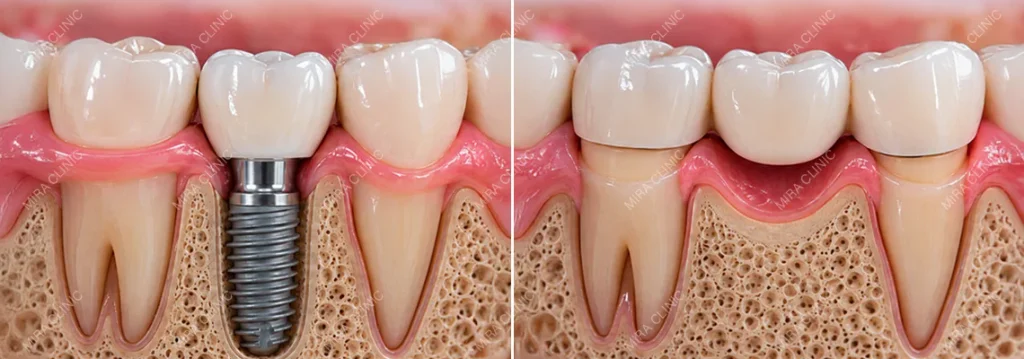
A dental implant is an artificial tooth root made of titanium that is placed in the jawbone to support a crown, bridge, or fixed denture. It is suitable for people who have lost one or more teeth, provided their jawbone condition and overall health allow them to undergo surgery.
Learn more about dental implant treatment at Lerraclinic, where treatment is provided at partner clinics and hospitals licensed to offer medical tourism services.
Table of Contents
Do You Feel Pain During Dental Implant Surgery?
Patients generally do not experience sharp pain during dental implant surgery because the dentist administers a local anesthetic injection to numb the area before beginning the procedure.
You may feel a brief needle prick at first, followed by pressure, vibrations, and the sounds of dental instruments, much like those experienced during any minor oral surgery.
If you feel any sharp pain during the procedure, inform your dentist immediately so that additional anesthesia can be administered.
According to guidance from Guy’s and St Thomas’ NHS Foundation Trust, local anesthesia ensures that patients do not feel pain during the procedure.
Placing a single dental implant usually takes approximately 30 minutes. The procedure may take longer when multiple implants are required, according to information provided by Cambridge University Hospitals NHS Foundation Trust.
Before your procedure, it is also helpful to review the steps involved in preparing for dental implant surgery.
What Types of Anesthesia Are Used for Dental Implants?
Local anesthesia is the standard option for dental implant surgery and is sufficient for most straightforward cases.
Conscious sedation, which is often administered intravenously, is generally offered to patients who experience significant anxiety or are undergoing lengthy procedures.
General anesthesia is reserved for selected cases involving extensive dental implant treatment or more complex surgery. This option is discussed and arranged with the medical team in advance.
| Type of Anesthesia | What You May Feel | When It Is Typically Used |
|---|---|---|
| Local anesthesia | A needle prick followed by pressure and vibrations, without sharp pain | Most cases |
| Conscious sedation | Relaxation and drowsiness while remaining responsive | Severe anxiety or lengthy procedures |
| General anesthesia | Complete unconsciousness throughout the procedure | Extensive surgery or selected cases |
After intravenous sedation or general anesthesia, you must not drive, operate machinery, or sign legal documents for 48 hours.
The cost may vary depending on the type of anesthesia used. The final price is determined after a medical assessment.
What Do You Feel After Dental Implant Surgery, Day by Day?
Discomfort after dental implant surgery begins as the anesthesia wears off and is usually most noticeable during the first few hours and the first two to three days.
Swelling typically peaks around the second day, after which most patients experience significant improvement over approximately one week.
In a study published in the journal Medicina Oral, which included 41 patients and 131 implants, most patients who experienced pain described it as mild. Among these patients, 41.5% reported that their pain peaked six hours after surgery.
Swelling was generally moderate and reached its peak 48 hours after surgery in 48.8% of cases.
| Stage | What You Typically Feel | What Can Help |
|---|---|---|
| First few hours after the anesthesia wears off | Pain begins and often reaches its peak | Take the prescribed painkiller before the anesthesia wears off, as directed by your dentist |
| Day 1 | Mild to moderate pain and slight bleeding | Cold compresses and rest |
| Days 2–3 | Swelling peaks, and bruising may appear | Keep your head elevated and eat soft foods |
| Days 4–7 | Pain and swelling gradually subside | Gradually return to your usual activities |
| End of the first week | Stitches are often removed; mild tightness may remain | Gently care for the surgical area |
| Second week | Most patients feel they have returned to normal | Continue following oral hygiene instructions |
| Implant exposure and abutment placement | A minor procedure with less discomfort | Follow your dentist’s instructions for the next few days |
| Taking impressions and fitting the crown | Mild pressure without surgery | Recovery is generally not required |
Stitches are usually removed after approximately one week, according to guidance from Guy’s and St Thomas’ NHS Foundation Trust.
How Long Does Pain Last After Dental Implant Surgery?
Pain after dental implant surgery typically lasts for a few days. It is usually most noticeable during the first two to three days before gradually subsiding over approximately one week in straightforward cases involving a single implant. This period corresponds to the initial healing phase.
Recovery may take longer when multiple implants are placed or bone grafting is required.
When Does Swelling Go Away After Dental Implant Surgery?
Swelling increases during the first 48 hours after dental implant surgery. In the Medicina Oral study, swelling peaked on the second day in approximately half of the patients, then gradually subsided over the course of the first week.
In more extensive procedures, such as the placement of multiple implants or bone grafting, bruising or mild swelling may persist for slightly longer.
Why Does Dental Implant Pain Vary from Person to Person?
The Medicina Oral study found an association between pain and the number of implants placed. It also found that swelling increased in the presence of the following factors:
- Number of implants: Swelling increased when more than four implants were placed during the same session.
- Bone grafting or sinus lifting: Both procedures were associated with greater swelling than implant placement alone.
- Implant location: Swelling was more pronounced in the back of the mouth, around the molars, than in the front teeth.
- Age: Greater swelling was observed in older patients.
Following postoperative instructions also helps promote a smoother recovery.
For this reason, the experience of undergoing full-mouth dental implants can differ from that of having a single implant placed.
Are Abutment Placement and Crown Fitting Painful Too?
The later stages of dental implant treatment are generally less uncomfortable than the initial implant placement procedure.
Guy’s and St Thomas’ NHS Foundation Trust explains that implants buried beneath the gum tissue require a second minor surgical procedure to expose them and attach the abutment.
By contrast, appointments for taking dental impressions and trying on the crown do not involve surgery, so discomfort is considerably less.
These stages take place after the implant has fused with the jawbone, a process known as osseointegration. Placing the abutment and fitting the final restoration typically take around one hour.
You can find the complete treatment timeline in our article on How Long Do Dental Implants Take in Turkey?.
Some patients may undergo a different treatment protocol known as immediate dental implants.
What Does This Mean If You Are Traveling to Turkey for Dental Implants?
If you are traveling to Istanbul for dental implant treatment, plan to spend the first few days after surgery resting, as this period is generally the most uncomfortable.
- Avoid strenuous sightseeing: Refrain from physically demanding tourist activities during the first few days.
- Keep your prescribed medication in your carry-on luggage: This will make it easier to access your medication during your return journey.
- Arrange soft food options in advance: Make sure suitable foods are available at your accommodation.
- Confirm your travel date with your dentist: Your treating dentist will advise you on when it is appropriate to travel based on your individual condition.
For more information about treatment options and costs, see our Guide to Dental Implants in Turkey.
How to Relieve Pain After Dental Implant Surgery
Follow these general steps to make your recovery more comfortable:
- Apply cold compresses: Place a cold compress on the outside of your cheek during the first day.
- Take painkillers as prescribed: Use only the medications recommended by your dentist, including anti-inflammatory medications if prescribed.
- Keep your head elevated: Use an extra pillow when sleeping.
- Choose soft foods: Eat soft foods that are cool or lukewarm, and avoid chewing on the side where the implant was placed.
- Avoid strenuous physical activity: Refrain from demanding exercise and heavy physical exertion during the first few days.
- Rinse gently with warm salt water: Begin the day after surgery, following your dentist’s instructions.
- Avoid smoking: Smoking can interfere with the healing process.
When Is Pain After Dental Implant Surgery Abnormal?
Pain after dental implant surgery may indicate a problem if it becomes worse after initially improving, particularly after the third or fourth day, or if it is concentrated around a specific implant.
Other warning signs that warrant contacting your dentist include fever, pus, persistent bleeding, numbness that continues after the anesthesia should have worn off, or a loose implant.
Contact your dentist if you experience any of the following:
- Pain that worsens after the third or fourth day instead of continuing to improve.
- Pain concentrated around a single implant.
- Fever, pus, or an unpleasant taste around the implant.
- Swelling of the gums or enlarged lymph nodes in the neck.
- Bleeding that does not stop after applying pressure with gauze for at least 10 minutes.
- Persistent numbness or tingling in the lip, chin, or tongue.
- An implant that feels loose or moves.
According to information from Cambridge University Hospitals NHS Foundation Trust, bleeding can usually be controlled by applying pressure for 10 minutes. Numbness caused by nerve involvement generally resolves within a few months, although it can rarely be permanent.
For more information, read our guide to the Signs of Dental Implant Failure.
Who May Not Be a Suitable Candidate for Dental Implants?
Dental implants may not be suitable for people with certain conditions, including untreated active gum disease, uncontrolled diabetes, severe jawbone loss, certain bone or autoimmune diseases, and poor oral hygiene.
Smoking can also impair healing.
A clinical examination is necessary to determine whether dental implants are appropriate for you. Learn more about the When Should You Avoid Implants?
Frequently Asked Questions About Dental Implant Pain
Are Dental Implants More Painful Than Tooth Extraction?
It depends on the individual case, and there is no definitive comparison that applies to everyone. A simple tooth extraction and straightforward single-implant placement are usually performed under local anesthesia, with temporary discomfort lasting a few days afterward.
However, surgical tooth extraction or implant placement combined with bone grafting may cause more swelling and require a longer recovery period. Your dentist can explain what to expect after examining your condition.
Can I Have Dental Implants While I Am Asleep?
This may be possible in selected cases using general anesthesia. Alternatively, conscious sedation can provide a deep sense of relaxation while allowing you to remain responsive.
Sedation is often considered when multiple implants are being placed or when patients experience severe dental anxiety. The appropriate option must be discussed and arranged with your medical team in advance, based on your health and the availability of the service.
Why Does It Hurt When I Chew on My Dental Implant?
Pain when chewing is generally normal during the first few days because the tissues surrounding the implant are still healing. For this reason, you are usually advised to chew on the opposite side of your mouth.
However, pain when chewing after the crown has been fitted or after healing is complete may indicate a problem with your bite or inflammation around the implant. You should arrange a dental examination to determine the cause.
Can I Return to Work Immediately After Dental Implant Surgery?
Cambridge University Hospitals NHS Foundation Trust generally recommends resting for the remainder of the day after surgery. Some patients may need to stay home for an additional day or so, depending on the nature of their work.
Patients with office-based jobs can generally return to work sooner than those whose jobs involve physical exertion. Your dentist will advise you based on the number of implants placed and the type of anesthesia used.
Is Dental Implant Surgery With Bone Grafting More Painful?
It often causes more swelling. Bone grafting and sinus lifting have been associated with greater swelling than implant placement alone.
Bone grafting may also add four to six months to the treatment timeline while the bone heals and becomes ready for implant placement. In most cases, any resulting pain can still be managed with prescribed painkillers.
Can Pain Return Months After Dental Implant Surgery?
Pain is not generally expected once the implant has fully healed. If pain develops months later, it may indicate inflammation around the implant, a problem with the bite or crown, or implant loosening.
Arrange a dental examination and X-rays without delay. Early diagnosis often makes treatment easier.
Conclusion
Are dental implants painful? The honest answer is that you generally do not feel pain during the procedure because of local anesthesia. However, temporary discomfort and swelling are expected afterward. These symptoms typically peak during the first few days and then gradually subside over approximately one week.
If you would like an assessment of your individual case, book your free consultation with Lerraclinic.
Contact us today and get the best offer!