
Last updated: November 2026
How to Choose a Dental Implant Clinic in Turkey? Start by checking the facility’s licence and the surgeon’s qualifications and specialisation. Request a clinical examination and dental imaging before accepting any quotation. Ask about the implant brand and crown material, and make sure you receive a written warranty with clearly defined terms and conditions. Finally, compare the complete treatment plans rather than looking at the price alone.
Lerra Clinic is a medical tourism company that coordinates treatment through licensed partner clinics and hospitals. We have created this checklist to help you evaluate any provider you consider working with, including us.
This article provides general information and does not replace a professional dental examination or an individual assessment by a qualified dentist.
Table of Contents
What Should You Check First When Choosing a Dental Implant Clinic in Turkey?
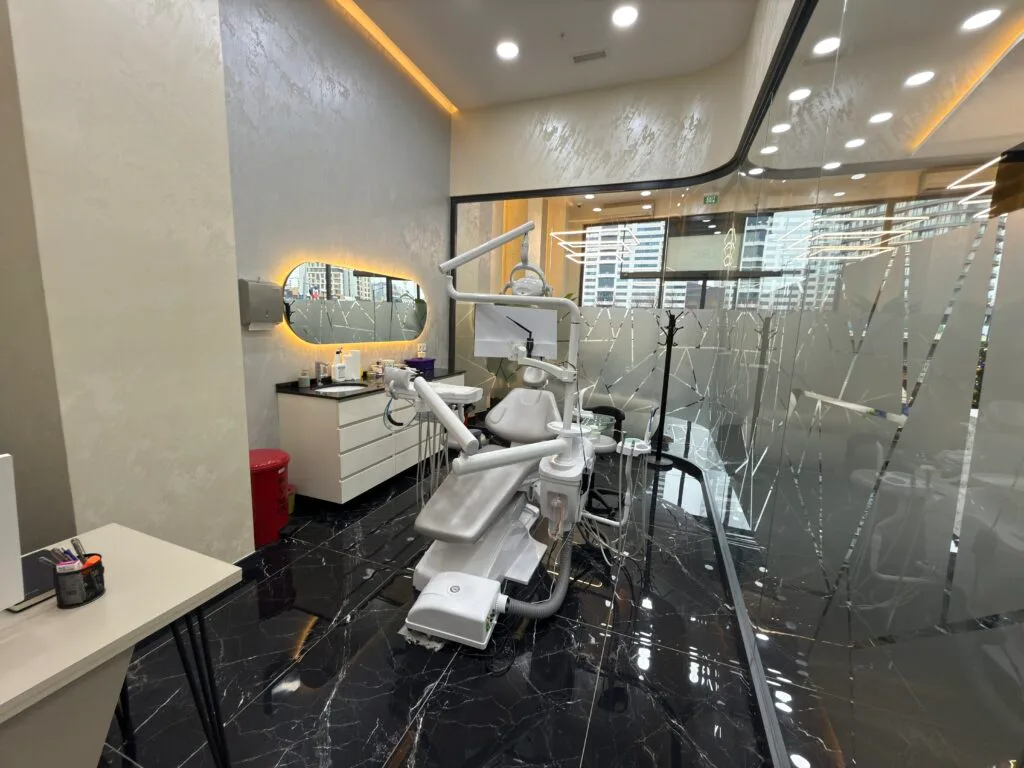
The first things to verify are the facility’s licence, the surgeon’s identity, and their professional specialisation. Is the facility licensed to treat international patients? Who will actually perform your surgery? And what experience do they have treating cases similar to yours?
Under Turkey’s regulations governing international health tourism, healthcare facilities must hold the appropriate healthcare licence and an International Health Tourism Authorisation Certificate issued by the Ministry of Health. Intermediary organisations involved in international health tourism must also hold the relevant authorisation.
The Ministry provides a directory of authorised healthcare providers, with separate lists for hospitals, medical centres, and private clinics. Search for the facility’s name to verify its authorisation.
If you are dealing with a medical tourism intermediary, ask for the exact name of the facility where your treatment will take place. Verify that facility independently rather than relying solely on the intermediary’s brand name.
You should also ask about the surgeon’s specialisation. Relevant fields include oral and maxillofacial surgery, periodontology (gum disease and treatment), and prosthodontics (dental restorations and replacements). Each specialisation is suited to different types of cases.
Requesting a brief video consultation with the actual surgeon before booking is entirely reasonable.
Do not rely solely on the number of years of experience advertised. Ask about similar cases the surgeon has treated, how their team handles potential complications, and who will provide follow-up care after you return to your home country.


Mistake #1: Asking for a Price Before an Examination and Dental Imaging
The first mistake is accepting a quotation before any clinical examination or dental imaging has been carried out. The number of implants required, whether bone grafting is necessary, and the position of important anatomical structures, such as the nerve, can only be properly assessed through appropriate examinations and imaging. All these factors can affect the treatment plan and overall cost.
A price provided without reviewing your dental images is only a general estimate based on an assumed case. It may change once the dentist has examined your condition.
Sometimes, an initially attractive quotation turns out to be much more expensive after you arrive, when additional items such as bone grafting or extra implants are added. This makes it difficult to compare offers fairly.
Before accepting any quotation, ask for:
- A clinical examination and dental imaging, or at least a preliminary assessment based on recent scans or X-rays that you provide.
- A written treatment plan specifying the number and positions of implants, as well as whether bone grafting or a sinus lift may be required.
- A clear explanation of how the price could change if unexpected findings arise during surgery.
It is also advisable to request a copy of the scans used to prepare your treatment plan. This allows you to share them with another dentist if you would like a second opinion before making your decision.
For more information about general safety considerations, read our article on Are Dental Implants in Turkey Safe?. Here, however, our focus is on choosing the right provider.
Mistake #2: Not Asking About the Implant Brand and Crown Materials
The second mistake is accepting vague assurances such as “high-quality dental implants” without finding out the implant brand, dimensions, crown material, and abutment type. These details can affect long-term maintenance, replacement options, and the quality of your warranty.
Each implant manufacturer has its own system of components. A dentist in your home country may not be able to tighten an abutment or replace a component unless they know the exact implant system used.
For this reason, knowing the implant brand, dimensions, and batch or lot number is your right as a patient, not a trade secret.
Ask the clinic for the following information and make sure it is provided in writing:
- Implant brand and model: The manufacturer, implant model, and total number of implants planned.
- Abutment type and crown fixation: Whether the crown will be screw-retained or cement-retained.
- Crown material: For example, zirconia or porcelain-fused-to-metal, and where the crown will be manufactured.
- Temporary teeth: Whether temporary teeth will be provided, what material they will be made from, and whether they are included in the quoted price.
- Implant passport: Whether you will receive an implant identification card containing these details when you leave the clinic.
Mistake #3: Accepting a Warranty Promise Without Written Terms and Conditions
The third mistake is relying on a verbal warranty promise. A warranty that does not clearly specify its coverage, duration, and conditions in writing may be difficult to rely on when you need it, particularly if you are living far away from the clinic.
Before making a payment, you should understand exactly what the warranty covers, what may invalidate it, how to submit a claim, and where any necessary repairs or replacements will be carried out.
For more detailed information about warranty coverage, read our article on dental implant warranty in Turkey.
Important questions to ask about the warranty:
- How long does the warranty last, and when does it begin?
- What exactly does it cover, and what is excluded?
- Are periodic visits or X-rays required to maintain the warranty? Who pays for them?
- Who is responsible for travel expenses if you need to return for repairs or corrective treatment?
- Will the warranty document be provided in writing, signed, and supplied as a copy for your records?
How to Compare Two Dental Implant Quotes Fairly
Compare quotations using identical treatment components rather than looking at the total price alone. Two offers with the same price may differ significantly in implant brands, crown materials, imaging, follow-up care, and warranty coverage.
The following table can help you organise your comparison.
| Item | Why It Matters | How to Verify It |
|---|---|---|
| Examination and dental imaging | Determines the actual treatment plan | Request a report identifying the imaging used |
| Implant brand and quantity | Affects maintenance and warranty coverage | Request the brand, model, and dimensions in writing |
| Abutment and crown | Determines durability and appearance | Ask about the materials and fixation method |
| Temporary teeth | Affects comfort during the healing period | Check whether they are included and what material is used |
| Bone grafting or sinus lift | May involve additional stages and costs | Ask whether these procedures are included or excluded |
| Follow-up care after returning home | Determines how potential problems will be addressed | Request details of communication channels and follow-up appointments |
| Warranty | Defines your rights if a problem occurs | Request the written warranty and its terms |
| Accommodation and transport | Affect the overall treatment cost | Ask exactly what is included in the quoted price |
Ask every provider to prepare their quotation using the same format. Then place the offers side by side and identify any missing items. This will help you understand the real differences between them rather than focusing only on the final figures.
If a provider cannot answer one of these questions before you pay, that in itself is useful information to consider when making your decision.
You should also ask what happens if your treatment plan needs to change during the procedure. How will the provider inform you of any changes, and will you be asked to approve additional costs before they are charged?
What Are the Warning Signs in Dental Implant Offers and Advertisements?
The most important warning signs include a fixed price offered without an examination, refusal to disclose the implant brand, pressure to pay quickly, inability to provide proof of the facility’s authorisation or identify the surgeon, and promises that are not supported by a written treatment plan.
Other signs worth paying attention to include:
- A promise to complete the entire treatment in a single day for every patient, regardless of their bone condition.
- Limited-time offers that expire within a few days and pressure you to make a decision before comparing alternatives.
- Reviews containing only generic praise without specific details about treatment or follow-up care.
- Before-and-after photographs that do not specify the procedure performed or when the photographs were taken.
- Communication that does not clearly identify the healthcare facility or the surgeon responsible for your treatment.
One warning sign alone does not necessarily mean a provider is unreliable. However, several warning signs appearing together are a good reason to slow down and request further clarification before proceeding.
What Risks Should Patients Not Ignore After Choosing a Clinic?

Choosing the wrong provider does not change the nature of dental implant surgery itself, but it can increase the risk of inadequate treatment planning and insufficient follow-up care.
The potential risks associated with dental implant surgery include infection, failure of osseointegration (the implant not successfully integrating with the jawbone), nerve irritation or injury, and complications involving the maxillary sinus.
These risks may be higher in patients who smoke, have poorly controlled diabetes, or have untreated gum disease. Your dentist should assess these factors during your examination before treatment begins.
The clearer and more thoroughly documented your follow-up arrangements are, the easier it becomes to identify potential problems early.
Following your surgeon’s instructions, contact your treating dentist or healthcare provider promptly if you experience any of the following after surgery:
- Numbness in your lip, chin, or tongue that persists after the local anaesthetic has worn off.
- A high temperature or swelling that continues to increase rather than subside.
- Pus or a persistent unpleasant taste coming from the surgical site.
- Bleeding that does not stop when pressure is applied with gauze.
- Movement of the implant or severe pain that is not controlled by your prescribed pain medication.
If you experience rapidly increasing swelling that makes swallowing or breathing difficult, seek emergency medical attention immediately.
Frequently Asked Questions About Choosing a Dental Implant Clinic
Is a Certificate of Accreditation or Licence Enough to Trust a Dental Clinic?
A licence is essential, but it is not enough on its own. It confirms that the facility operates within the legal framework, but it does not measure the quality of your individual treatment plan or the surgeon’s experience with cases like yours.
Consider the facility’s authorisation alongside the surgeon’s specialisation, a written treatment plan, a clearly identified implant brand, and transparent warranty coverage. You should also assess how willing the provider is to answer your questions in detail.
Is a Low Price a Sign of Poor Quality?
Not necessarily. Prices vary depending on operating costs, implant systems, crown materials, and what is included in the treatment package.
However, an unusually low price offered without an examination or a detailed breakdown should prompt you to ask exactly what is included and what is excluded.
Compare identical treatment components rather than looking at the total price alone, and make sure everything you have been promised is documented in writing.
Can I Speak to the Surgeon Before Booking?
Yes. It is entirely reasonable to request a telephone or video consultation with the surgeon who will actually perform your procedure.
This gives you an opportunity to discuss your treatment plan and ask about their experience with similar cases.
If the clinic cannot arrange this before you pay, without a clear explanation, ask for the surgeon’s full name and written confirmation of their role in your treatment. Knowing who will be responsible for your care is an important part of making an informed decision.
Are Online Patient Reviews Enough to Make a Decision?
Patient reviews can be helpful, but they should not be your only source of information. The overall rating and number of reviews do not tell you what treatment was performed or what happened after the patient returned home.
Look for detailed reviews that mention the specific procedure, follow-up care, and the length of time since treatment. Be cautious of reviews that sound almost identical.
Use patient feedback alongside the written treatment plan and the provider’s answers to your questions before making a decision.
How Many Dental Implant Quotes Should I Compare?
There is no fixed number, but comparing two or three quotations based on the same dental scans and treatment requirements is usually enough to give you a clearer picture.
The important thing is to make sure all quotations are based on comparable examinations or imaging and that you request the same breakdown of treatment components from every provider.
Comparing offers with different treatment scopes will not give you a meaningful result.
What Should I Do If a Clinic Refuses to Provide a Written Treatment Plan and Warranty?
Treat this as a warning sign. Repeat your request in writing and make it clear that you will not proceed with payment until you receive both documents.
If the provider continues to refuse, keep a record of your correspondence and consider comparing your options with another, more transparent provider.
A written treatment plan and warranty are essential documents that help protect your rights, particularly when you are receiving treatment abroad and living far away from the clinic.
Conclusion
When choosing a dental implant clinic in Turkey, start by checking the facility’s authorisation and the surgeon’s qualifications. Request dental imaging before accepting a price, ask about the implant brand and materials, and insist on a written warranty.
Compare treatment plans using identical components, and take your time rather than giving in to pressure to pay quickly.
If you would like to apply this checklist to your own situation with Lerra Clinic, you can contact us through our Contact Us page and prepare any recent dental scans you may have.
This content was written and reviewed by the Lerra Clinic Medical Content Department.
Contact us to learn more about our treatment offers.
Contact us today and get the best offer!